
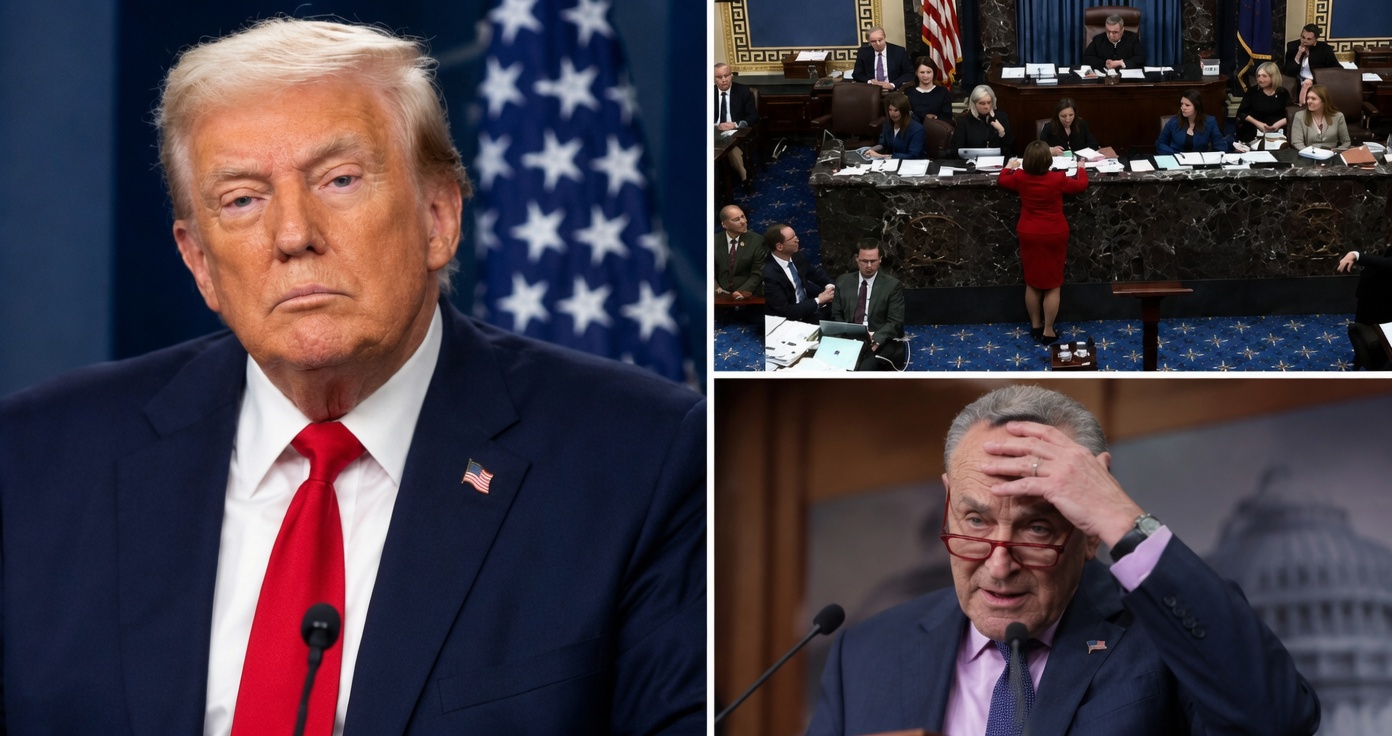
President Donald Trump is well into his second and final term, but he is still working to fill crucial vacancies within his government.
That includes filling the director of national intelligence role after former DNI Tulsi Gabbard stepped down earlier this year to care for her sick husband.
Trump’s nominee to lead the nation’s intelligence agencies moved closer to confirmation Monday, bringing the Senate closer to restoring a key counterterrorism authority.
The Senate voted to advance Jay Clayton’s nomination as the next DNI. Gabbard left after doctors diagnosed her husband with cancer.
The procedural vote passed largely along party lines, 51-43.
Clayton, who previously served as chairman of the Securities and Exchange Commission (SEC) during Trump’s first term, advanced after narrowly clearing the Senate Intelligence Committee on a 9-8 vote, as Democrats continue to oppose everyone Trump nominates and everything Trump tries to do.
Senate Majority Leader John Thune, R-S.D., urged Democrats to support Jay Clayton’s nomination during the final confirmation vote, while acknowledging that he expected continued opposition similar to what many of Trump’s second-term nominees have faced.
“One might think that we’d be seeing some bipartisanship from Democrats on this nominee,” Thune said on Monday.
“But Democrats are playing the same partisan games with this qualified nominee as they have for so many of President Trump’s picks,” he continued.
“It’s a funny thing because Democrats have made no secret of their disdain for the current acting Director of … National intelligence,” he continued.
“In fact, Democrats were so worked up over the president’s temporary choice for this position, they allowed our nation’s most important counterterrorism tool to go dark for the first time ever,” he reminded the chamber.
The Senate is scheduled to hold a final confirmation vote Tuesday, bringing to a close the process of selecting a successor to Gabbard.
After she announced her departure, Trump appointed Federal Housing Finance Agency (FHFA) Director Bill Pulte to serve as acting DNI, overseeing the nation’s 18 intelligence agencies on an interim basis.
Since then, Pulte has gone on a firing spree, weeding out so-called “deep state” operatives who were found to be working discreetly to thwart the president’s agenda.
Gabbard’s exit came as the Senate was nearing a vote on a bipartisan agreement to extend Section 702 of the Foreign Intelligence Surveillance Act (FISA), a key counterterrorism authority that was approaching its expiration, Fox News Digital reported.
Democrats, who sharply criticized Pulte and argued he lacked the qualifications for the role, accused him of seeking to politicize the intelligence community by targeting Trump’s political opponents and restructuring the nation’s intelligence agencies.
Following Trump’s decision to cancel Clayton’s previously scheduled confirmation hearing, Democrats withdrew from the bipartisan agreement to extend Section 702.
Less than 24 hours before Clayton cleared his final procedural hurdle, Pulte announced on X that he had completed his fourth round of layoffs as acting Director of National Intelligence.
“Since becoming Acting Director of National Intelligence, our team has been smartly, and carefully, reducing the size of ODNI, re-focusing ODNI on national security, the law, and the statute,” Pulte said.
“As of this evening, we just finished a 4th round of thoughtful, measured layoffs. Thank you!” he added.
Since then, the Section 702 surveillance program has gradually become inoperative, with new authorizations stalled until Congress reauthorizes the intelligence authority.
Supporters of the program argue it has played a critical role in preventing terrorist attacks, including helping disrupt an alleged mass-casualty plot targeting a Taylor Swift concert in Vienna, Austria.
Last week, Clayton’s nomination advanced out of the Senate Intelligence Committee with support only from Republican members.
During his confirmation hearing, Democrats questioned him about the 2020 presidential election, his knowledge of Gabbard’s reported actions involving the Fulton County, Georgia, election offices, and subpoenas issued to New York Times reporters while he served as the top federal prosecutor for the Southern District of New York.