
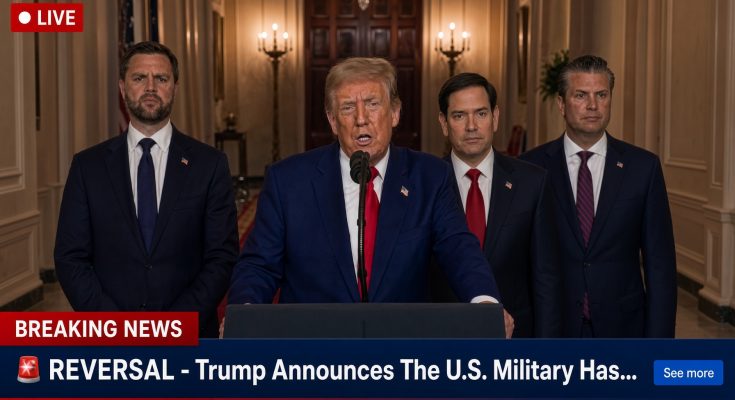
WASHINGTON — President Donald Trump declared Thursday that the conflict between the United States and Iran was effectively over after announcing that he had canceled additional U.S. military strikes, signaling a dramatic shift from confrontation toward negotiations.
Speaking during a tele-rally supporting Georgia Lt. Gov. Burt Jones in his campaign for governor, Trump said the two countries had reached a point where diplomacy could potentially replace further military action.
“I don’t know if you heard, but we ended the war with Iran today,” Trump said.
The president said a central condition of any agreement would be Iran’s commitment not to develop a nuclear weapon. According to Trump, that issue represented the overwhelming majority of the U.S. objective in the conflict.
“They have agreed never to have a nuclear weapon,” Trump said, describing the issue as “95 percent” of the purpose behind the military campaign.
Despite his announcement, Trump indicated that the situation was not yet fully resolved. He said the U.S. naval blockade affecting the Strait of Hormuz would remain in place until a formal agreement was completed.
Negotiations Move Toward Final Agreement
Trump said representatives would meet in Switzerland to finalize the proposed arrangement, with reports suggesting that a formal agreement could potentially be signed within days.
The development followed a period of intense military escalation between Washington and Tehran. Trump said he had discussed the emerging agreement with Israeli Prime Minister Benjamin Netanyahu as well as leaders from several other countries in the region.
Netanyahu’s office later confirmed the conversation and said Israel welcomed Trump’s commitment to ensuring that any final agreement would impose significant restrictions on Iran’s nuclear program and address other activities considered destabilizing.
However, Israel was not described as a direct participant in the negotiations.
Trump said in a social media statement that discussions had reached Iran’s highest levels of leadership and that the progress prompted him to cancel additional strikes that had been scheduled.
Strait of Hormuz Remains Critical
The Strait of Hormuz remains one of the most strategically important waterways in the global energy system. A substantial share of the world’s seaborne oil and liquefied natural gas shipments passes through the narrow waterway, making any disruption a major concern for international markets.
The prospect of reduced tensions prompted a positive response from financial markets. European stocks moved higher as investors assessed the possibility that a diplomatic agreement could reduce the risk of prolonged disruptions to global energy supplies.
Oil prices also declined amid expectations that easing tensions could reduce the likelihood of further interruptions to shipments through the region.
Military Campaign Preceded Diplomatic Shift
Trump’s announcement came after days of escalating military activity.
The president had previously warned that Iran would face severe consequences if negotiations failed. In a social media post, he described Iran’s military capabilities as severely damaged and warned Iranian leaders that they would pay a price for delaying negotiations.
U.S. Central Command also announced that American forces had conducted additional self-defense strikes against targets inside Iran at the president’s direction.
The latest development therefore represents a significant change in tone—from military pressure and threats of additional attacks to negotiations aimed at establishing a longer-term arrangement.
A Fragile Path Forward
Despite Trump’s declaration that the war is over, a final agreement has not yet been formally signed. Important questions remain regarding the precise terms of any deal, enforcement mechanisms, Iran’s nuclear commitments and the future of the Strait of Hormuz blockade.
The coming days could therefore prove decisive.
If negotiators successfully finalize an agreement, the development could mark a major diplomatic breakthrough with consequences for energy markets, regional security and relations between Washington and Tehran.
If negotiations fail, however, the possibility of renewed confrontation could quickly return.
For now, Trump is presenting diplomacy as the next stage of the conflict, while governments and markets around the world wait to see whether the proposed agreement can turn a fragile pause in hostilities into a lasting settlement.